
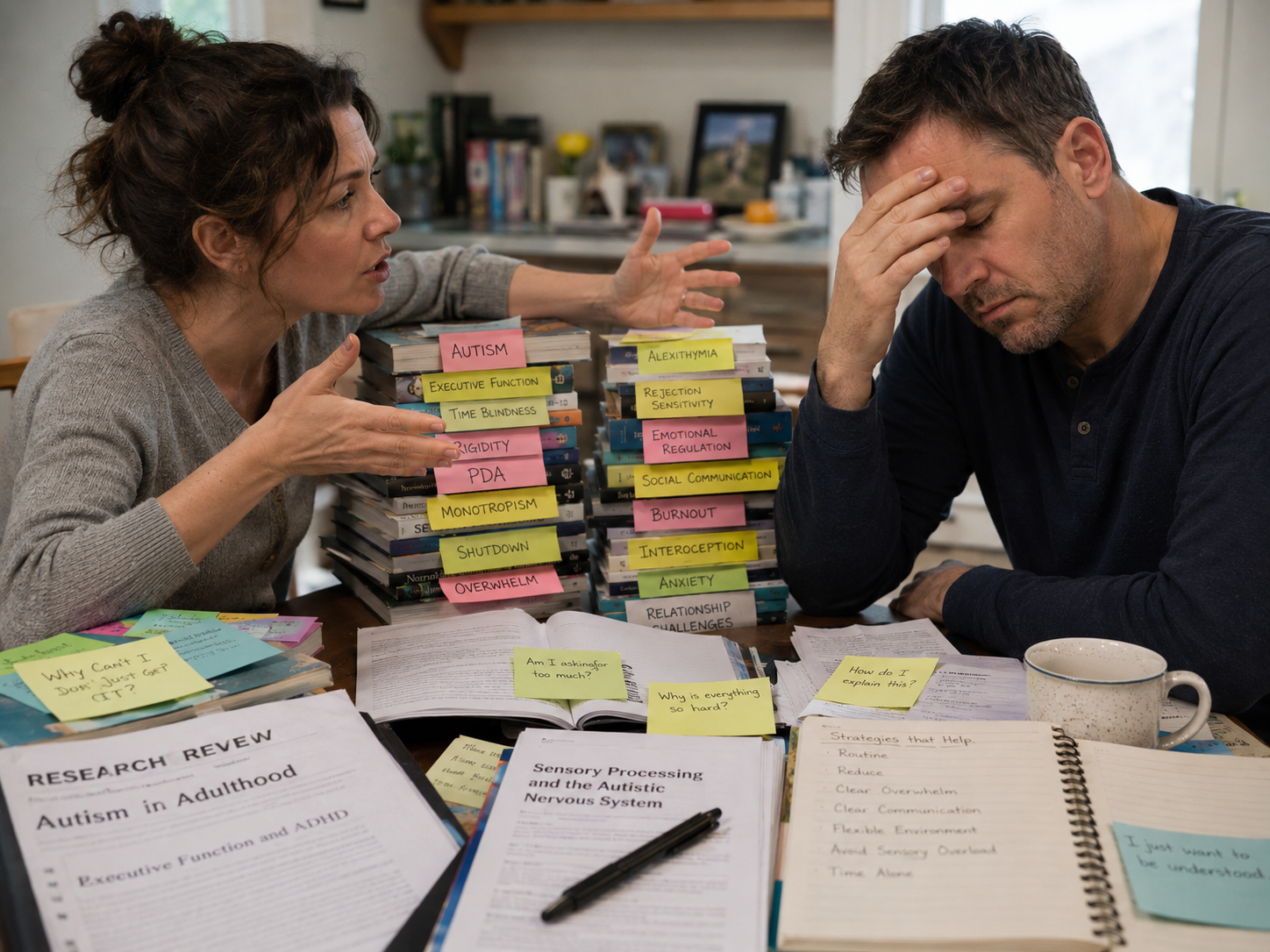
One of the easiest things to do in a neurodiverse relationship is turn every disagreement into a graduate-level research project. Your spouse forgets to take out the trash, and suddenly you are mentally flipping through every article you have ever read about executive functioning, time blindness, demand avoidance, working memory, task initiation, cognitive flexibility, monotropism, nervous-system regulation, rejection sensitivity, sensory processing, and childhood trauma.
The trash is still sitting there, but now we have a dissertation on autism and/or ADHD inside your head.
This happens all the time. Something feels wrong, hurtful, frustrating, confusing, or completely illogical, and we immediately reach for the neurological encyclopedia. We start explaining the person instead of addressing the problem.
“This is your rigidity.”
“This is your black-and-white thinking.”
“This is your time blindness.”
“This is your PDA.”
“This is your autistic inertia.”
“This is your rejection sensitivity.”
“This is your inability to transition.”
“This is your hyperfocus.”
“This is your nervous system entering a protective response because of unresolved developmental patterns.”
Meanwhile, your spouse is standing in the kitchen holding a cereal bowl, wondering how breakfast became a clinical case conference.
Sometimes the explanation may be accurate... That does not mean it is helpful.
Your spouse with autism (Asperger’s) or ADHD probably does not want every mistake, disagreement, forgotten chore, badly worded sentence, missed cue, late arrival, emotional shutdown, or questionable dishwasher-loading technique connected back to a diagnosis. Nobody wants to live with a running neurological commentary track.
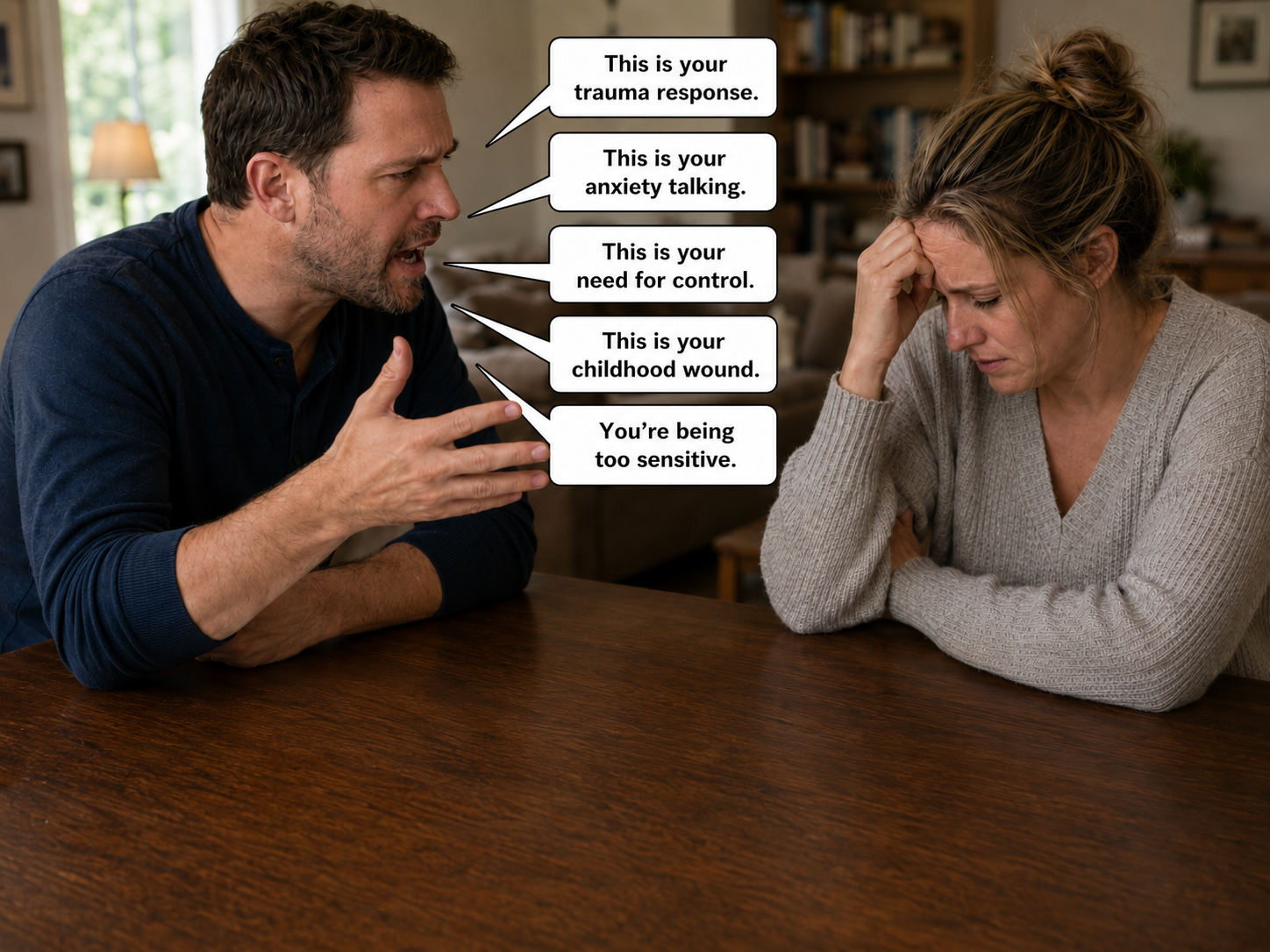
Imagine if every time you became upset, your spouse responded with, “This is your trauma response,” “This is your anxiety talking,” “This is your need for control,” or “This is your childhood wound.” You probably would not smile warmly and say, “Thank you for that insightful observation. I feel deeply understood.”
Understanding neurodiversity matters. It can bring compassion, context, and clarity. It can help couples stop assigning negative intent where there may be overwhelm, confusion, missed communication, or a genuine skill gap. But understanding should help you solve the problem. It should not become a weapon, an excuse, a permanent label, or a way to win an argument.
At some point, we have to stop diagnosing the moment and deal with the moment if we want something better.
He forgot the appointment. She interrupted you. He shut down. She became overwhelmed. He agreed to something and did not follow through. She assumed you understood something that was never clearly stated. You do not always need to identify the exact neurological pathway that led you there. Sometimes you simply need to ask what happened, what each person understood, and what needs to change next time. You need something practical...
Do you need a system? A reminder? A clearer expectation? A repair? A boundary? A written plan? A shared calendar? A thirty-second conversation instead of a forty-five-minute lecture on executive dysfunction?
That is usually far more useful than announcing, “This is clearly your pathological demand avoidance interacting with your executive-function deficits,” especially when the original request was, “Can you put your shoes away?”
Not Everything You Consume Is Helping You

There is no shortage of information available about autism, ADHD, neurodiverse marriage, Asperger’s, Cassandra Syndrome, PDA, executive functioning, emotional regulation, attachment, trauma, and relationships. There are books, podcasts, YouTube channels, blogs, Facebook groups, therapists, coaches, researchers, interviews, webinars, studies, documentaries, and people on social media who made three videos and now speak with the confidence of someone who personally invented the human brain.
Some of it is excellent. Some of it is helpful for a season. Some of it is incomplete. Some of it is destructive.
Some content teaches understanding, while other content teaches hopelessness. Some helps you build skills, while other content simply gives you new vocabulary for the same fight you have been having for ten years. You can become so educated about why your marriage is difficult that you stop doing anything that could make it better.
You can learn every possible reason your spouse struggles and still never create a calendar, set a boundary, communicate clearly, make a repair, or change a pattern. You can know the official name for every problem and still remain completely stuck inside it.
Information is only valuable when it helps you move forward.

When you read a book, watch a video, listen to an interview, join a group, or hear another expert explain your relationship, ask yourself what the information is producing in you. Is it helping you understand your spouse without excusing harmful behavior? Is it helping you communicate more clearly, build better systems, increase accountability, or make wiser decisions?
Most importantly, is it helping you write your redemption story, or is it keeping you trapped in your old chapter with history repeating over and over again?
Some resources keep people circling the same pain. They explain the past repeatedly, reinforce the same labels, and convince you that the pattern is permanent. You may feel deeply validated, but validation without direction can become another place to live.
You were never meant to build a permanent home inside the worst chapter of your story.
Your marriage may need compassion, but it may also need structure. It may need greater understanding, but it may also need clearer boundaries. It may need grace, but it may also need accountability. It may need less analyzing and more doing.
Keep the Explanation, Lose the Lecture

This does not mean you should ignore neurodiversity or pretend autism and ADHD have no impact. They do. Understanding how a person processes information, handles transitions, manages sensory input, tracks time, regulates emotions, or initiates tasks can be incredibly important.
The problem begins when every disagreement becomes a diagnosis and every bad decision becomes a symptom.
Your spouse is still a person. They are not “the autistic partner,” “the ADHD spouse,” a collection of traits, or a research paper you are trying to peer review. They are the person you married, and they probably do not want to hear that they are “trapped in rigidity and unable to overcome it” every time they disagree with you.
Sometimes they are rigid.
Sometimes you are rigid.
Sometimes they misunderstood.
Sometimes you explained it badly.
Sometimes executive functioning is involved.
Sometimes someone just did not want to do the thing.
Not every frustrating behavior requires a conference panel.
The goal is not to perfectly explain every past failure. The goal is to stop repeating it. Learn what is useful, put down what is not, create simple systems, state clear expectations, address the actual behavior, hold appropriate boundaries, make repairs, and practice new skills.
And please, for the sake of your marriage, occasionally let the cereal bowl just be a cereal bowl.
Coaching Should Help You Move Forward
This is also what makes Neurodiverse Coaching different. My goal is not to keep couples endlessly analyzing their marriage, reliving every painful moment, or becoming dependent on me to make every decision. I do not want to become another voice that keeps you trapped in the same chapter while giving you increasingly complicated names for why you are still there.

I want to help you understand what is happening, identify what can actually change, and build practical strategies that work in your real life. That may mean improving communication, creating systems, setting boundaries (not barriers), repairing trust, increasing accountability, or learning how to work with your different brains instead of constantly fighting against them. We focus on the goals in front of you and the steps that will help you reach them.
The purpose of coaching is not for you to need me forever. The goal is for you to develop the clarity, skills, structure, and confidence to continue thriving long after our work together ends. I want to help couples make real progress, reach their goals, and then send them forward equipped to keep building a healthier marriage.
Because success is not staying in coaching indefinitely. Success is reaching the point where the right strategies are built into your marriage, you are set up to handle challenges more effectively, and the old patterns no longer keep pulling you back into the same chapter. My goal is to help you create a clear path forward, establish what you need to succeed, and leave coaching prepared to continue thriving together.
If you are tired of analyzing the same problems, repeating the same conversations, and ending up in the same place, it may be time for a different strategy. Book a session with Neurodiverse Coaching, and let’s stop overcomplicating it, identify what is actually keeping you stuck, and create a practical plan that sets you and your marriage up for success.
Read next: Wedding Rings… And Other Sensitivities